
Two Roads to Pane Nero, Part Two: The Math Finally Catches Up
Back in June I wrote about Two Roads to Pane Nero — two loaves built from the same idea (adapt Gustiamo’s Pane Nero formula to European flour) but forced down completely different paths: a Swiss multigrain fighting flaxseed mucilage that locks up water before gluten ever gets a chance, and a Sicilian durum loaf built around Tumminia’s famously weak gluten. Both loaves converged on surprisingly similar oven spring despite opposite starter strategies, and I ended that post admitting I hadn’t even cut into them yet — “cutting in too early risks a gummy slice.”
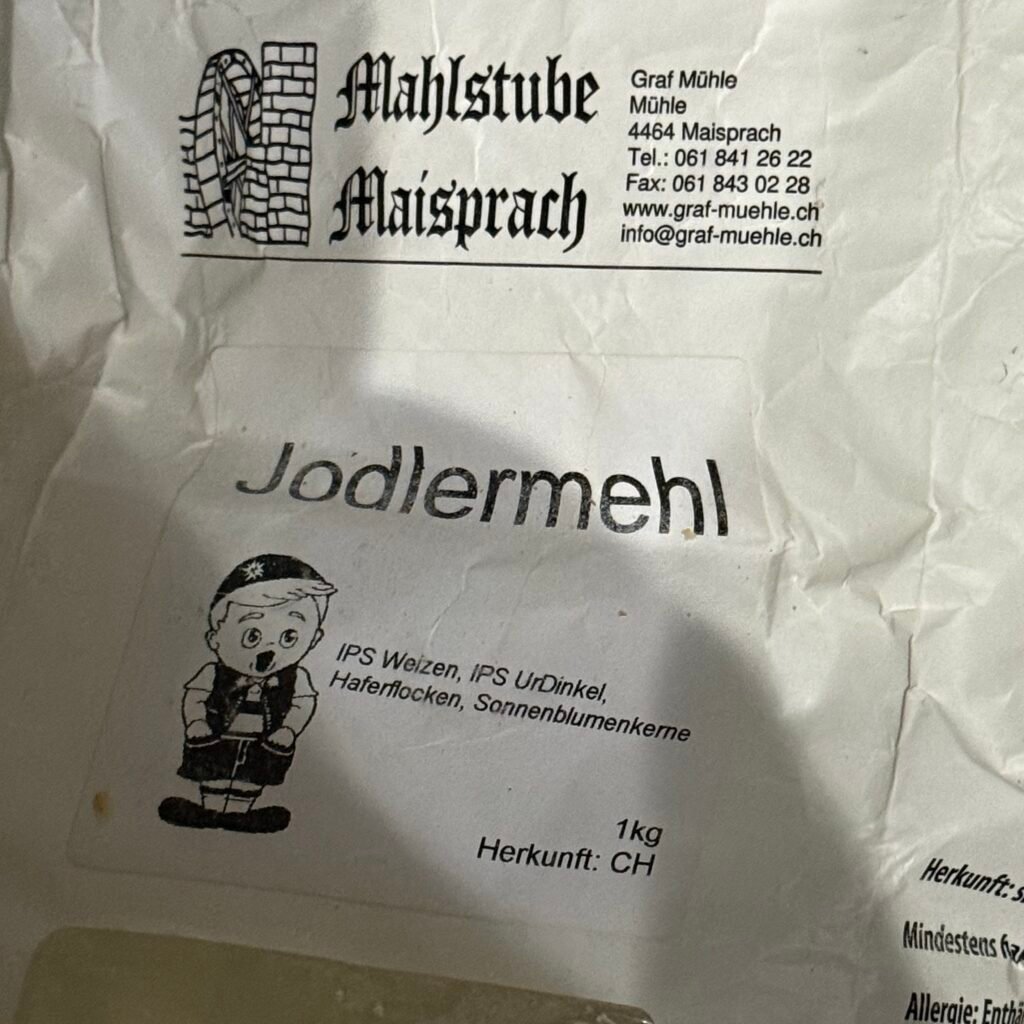
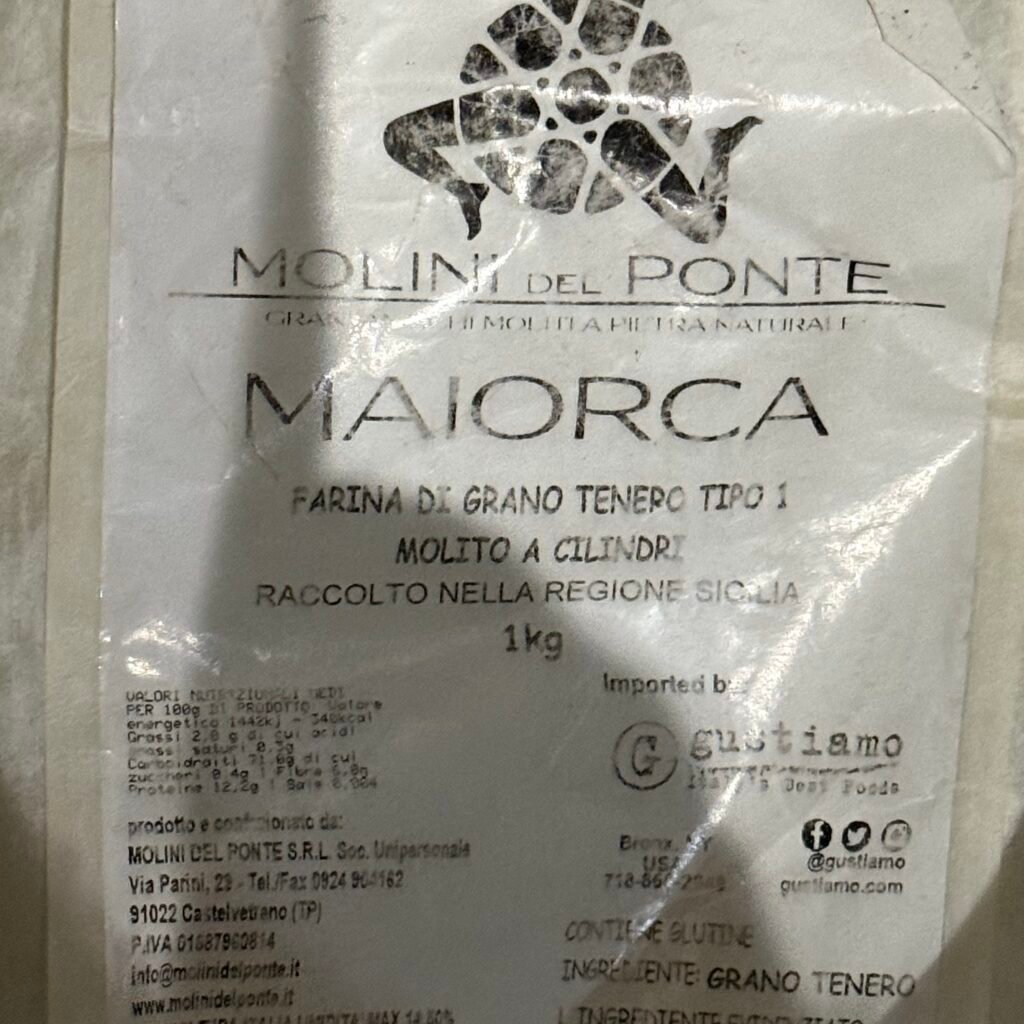
This time I’m finishing what I started. Same two mills — Mahlstube Maisprach in Switzerland, Molini del Ponte in Castelvetrano, Sicily — same instinct that these flours belong in a Bauernbrot-style multigrain and a sesame-crusted pane nero di Castelvetrano. But almost everything about how I got there changed, down to the flour blend itself: last time “Pain Noir” stood in as the whole Swiss loaf; this round I paired it with a lighter Jodlermehl blend (wheat, spelt, oats, sunflower seeds) instead of running it alone. And this time, I actually got the crumb shot.
Four flour bags, down to their last scrapings, two breads, and — unlike round one — the baker’s math actually holds together.
Weighing what was left
Step one was just honesty about quantities. No guessing “about 200g” — onto the kitchen scale everything went, more than once, as I kept re-checking and correcting:
- Jodlermehl: 452g
- Pain Noir: 317g
- Bianco di Tumminia: 517g
- Maiorca: 254g
That’s 769g of Swiss blend and 771g of Sicilian blend — almost a dead heat, which felt like a sign these two loaves were meant to be baked side by side.
Building the calculator
Rather than do baker’s-percentage math by hand every time I second-guessed a number, I put together a small spreadsheet: a Flour Inventory tab feeding two recipe tabs, one per bread, all linked by formula so changing a flour weight recalculates everything downstream — hydration, salt, yeast, levain build, split plan, all of it.
Targets landed at 70% hydration and 2% salt for the Swiss dough, 72% hydration and 2% salt for the Sicilian — durum drinks a little more water than a wheat/rye blend before it feels right.
Then vs. now
Round one leaned on Gustiamo’s Pane Nero formula more or less as written — a flat 75% hydration and a choice between 30% liquid levain (licoli) or 20% firm levain (lievito madre), applied across both loaves despite them being built from completely different flour systems. It worked, in the sense that both loaves rose and baked, but it papered over a real problem: American bread flour runs high-protein, European flour runs softer, and a single hydration number doesn’t actually fit both.
This time each bread got its own number instead of a shared one. The Swiss dough came in a few points under that old 75% baseline — partly because I finally had the linseed-mucilage problem from round one in mind: the flaxseed in Pain Noir binds water on its own before gluten gets any, so a lower stated hydration still behaves wetter than the number suggests. The Sicilian dough went the other way, up to 72%, because this time the goal wasn’t just surviving Tumminia’s weak gluten with a firm levain — it was giving it enough water to actually open up.
The levain question (and where I got it wrong the first time)
Since one loaf of each bread was earmarked as a gift for my cousin, I wanted the flexibility of a split bake: one loaf baked the same day, one shaped and cold-retarded overnight. That meant deciding on a real levain build instead of leaning on commercial yeast alone.
For the Swiss dough I went with a liquid levain — around 100% hydration, rye-sourdough style — because rye ferments and hydrates beautifully when kept loose, and a liquid levain’s faster, milder acidity doesn’t fight with rye’s own flavor. My actual feed ratio was 120g flour : 120g water : 30g starter — 100% hydration, 25% inoculation.
For the Sicilian dough I built a firm levain instead — closer to 50% hydration, in the style of a Sicilian criscente or lievito madre — because durum’s weaker, less extensible gluten benefits from the backbone a stiff levain gives it, and it keeps the flavor mild and nutty rather than sour. I used a 100:200:100 (starter:flour:water) build, which works out to 50% hydration at 50% inoculation.
Here’s the part I got wrong on the first pass: I’d built the spreadsheet assuming the levain’s flour was drawn from the same weighed Swiss or Sicilian blend — meaning I was subtracting flour from my already-scarce inventory to “pay for” the levain. But that’s not what I actually did in the kitchen. I fed both levains with separate flour entirely — rye for the Swiss levain, wheat for the Sicilian one — which meant every gram of my 769g and 771g blends was still fully available for the main dough.
That was the adjustment that mattered most. I re-derived the math so the levain’s target percentage solves against the finaltotal dough weight, not the blend alone, and made the levain’s flour and water genuinely additive rather than borrowed. The blend never gets reduced; the levain shows up as pure bonus mass at the final mix. Small fix, but it’s the difference between a recipe that’s internally honest and one that quietly shorts you flour on bake day.
With that fixed:
- Swiss levain: 20% of final dough → about 331g total, split roughly 147g fresh rye flour / 147g water / 37g mature starter
- Sicilian levain: 25% of final dough → about 447g total, split roughly 224g fresh wheat flour / 112g water / 112g mature starter
A pinch of insurance
Both doughs also got a genuinely small pinch of instant yeast alongside the levain — about 0.2% of the blend’s flour weight, so a couple grams at most. Not enough to mask the levain’s flavor, just enough insurance that fermentation wouldn’t stall out on a cool day, especially useful with two loaves on two different schedules.
The split plan
Once the total dough weight was locked (about 1,655g for the Swiss, 1,790g for the Sicilian), each batch got divided 50/50:
- Loaf A — shaped, proofed at room temperature, baked the same day
- Loaf B — shaped, popped straight into a banneton in the fridge, baked cold the next day
Bulk fermentation got a handful of folds early on to build strength, then was left alone to finish rising — rye and durum both reward a gentler hand than a straight bread-flour dough.
Bake day, twice over
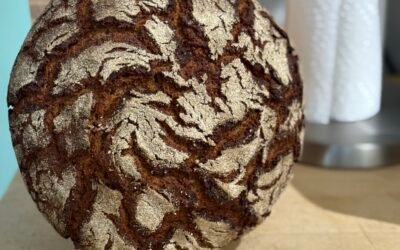
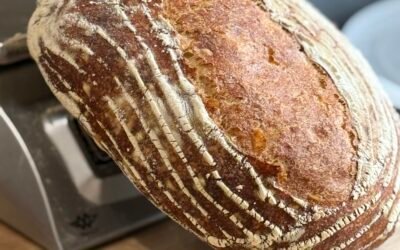
The direct loaves went in first: the Swiss multigrain on a preheated baking steel with steam, and the Sicilian sesame-topped boule in a Dutch oven. Both came out with strong oven spring, good ear formation along the score lines, and that particular toasted-sesame smell that makes the whole kitchen worth it.
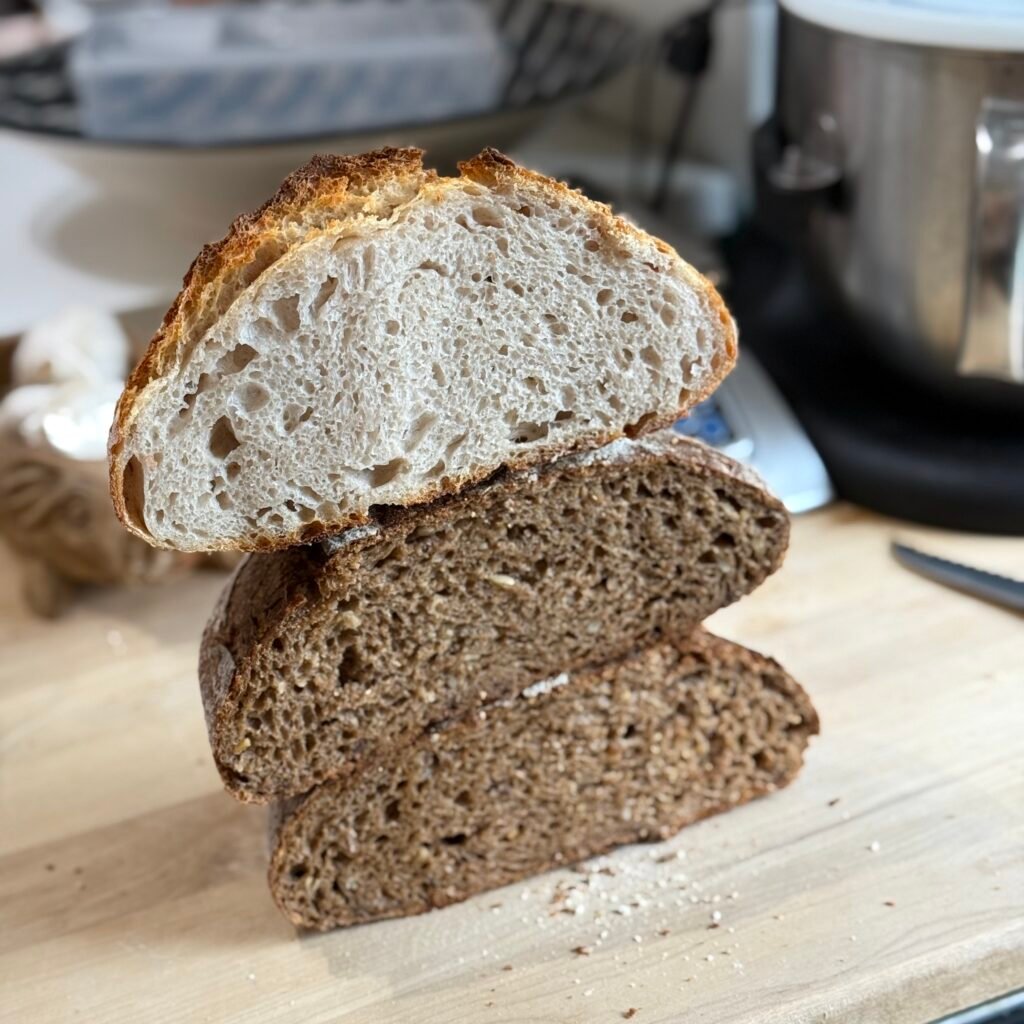
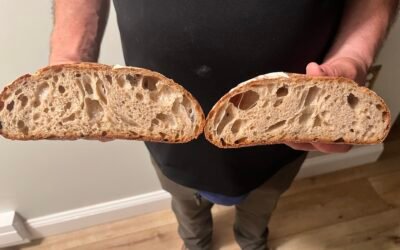
The retarded loaves followed a day later, baked cold straight from the fridge — the Sicilian one in the Dutch oven this time, coming out with a deep golden durum crust and a wildly open, creamy crumb from the extra overnight fermentation. The Swiss retarded loaf held its dense, dark, seed-flecked crumb but stayed tender, no gumminess anywhere, even after the longer cold ferment.
Cutting all four open side by side told the real story — and this is the part I chickened out of last time, when I let the loaves rest and moved on rather than risk a gummy slice. No such hesitation this round: the Sicilian crumb came out pale, open, and full of irregular holes, while the Swiss crumb stayed close and hearty with visible rye and seed running through it. Two totally different breads from two totally different corners of Europe, both born from flour that was almost gone, and both finally cut open to prove it.
The victory lap: pane cunzato
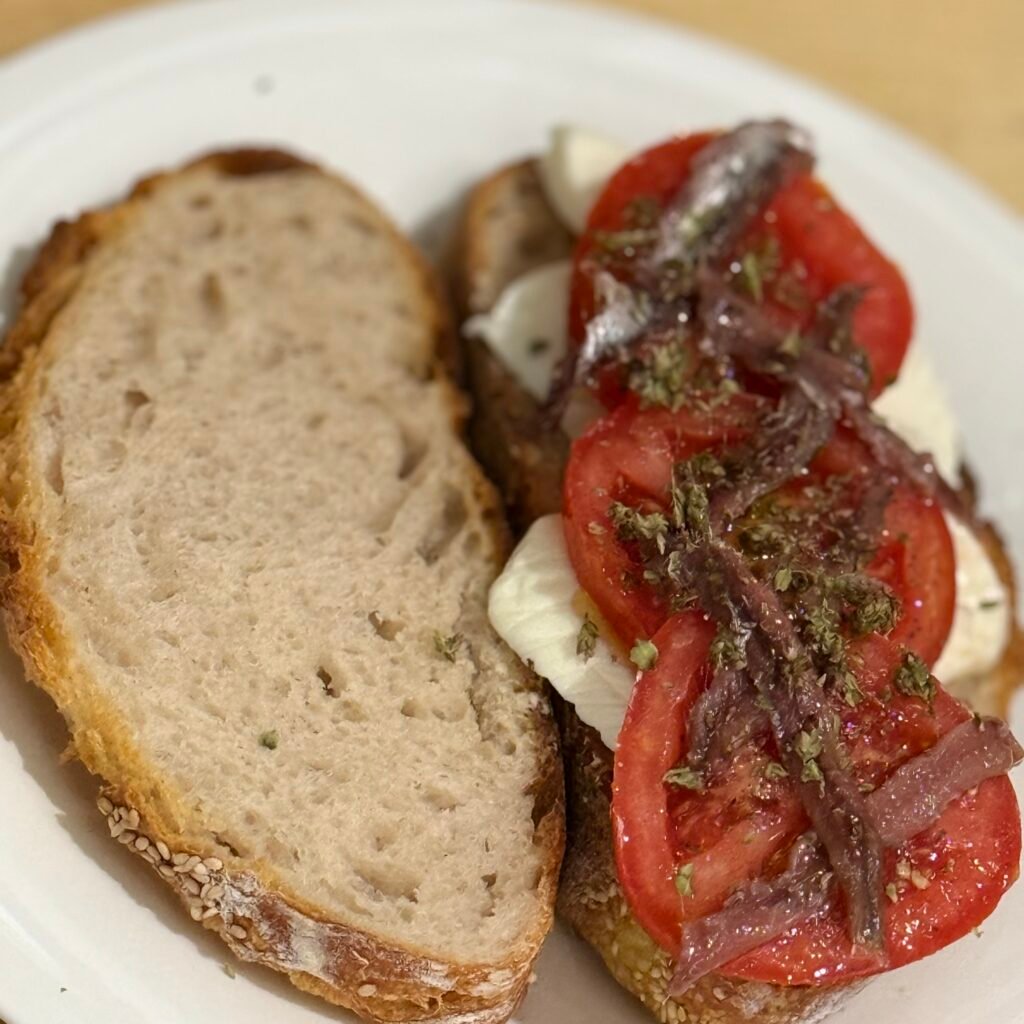
With bread this good, there was really only one way to finish — pane cunzato, the classic Sicilian way of dressing up crusty bread: thick slices of the Sicilian loaf, ripe tomato, primosale, a scattering of anchovies, dried oregano, and a heavy pour of good olive oil. No cooking required, no need to improve on it. It’s the dish that exists specifically to let a good loaf of bread be the main event, and this loaf earned it.
Recipe card — Swiss Multigrain (Jodlermehl + Pain Noir)
| Ingredient | Baker’s % | Amount |
|---|---|---|
| Jodlermehl | — | 452g |
| Pain Noir | — | 317g |
| Total flour | 100% | 769g |
| Water | 70% | 538g |
| Salt | 2% | 15g |
| Instant yeast (hybrid pinch) | 0.2% | ~1.5g |
| Levain (liquid, rye, 100% hyd., 25% inoculation) | 20% of final dough | ~331g |
| Total dough weight | ~1,655g | |
| Split (direct / retard) | 50 / 50 | ~827g each |
Recipe card — Sicilian Pane Nero (Tumminia + Maiorca)
| Ingredient | Baker’s % | Amount |
|---|---|---|
| Bianco di Tumminia | — | 517g |
| Maiorca | — | 254g |
| Total flour | 100% | 771g |
| Water | 72% | 555g |
| Salt | 2% | 15g |
| Instant yeast (hybrid pinch) | 0.2% | ~1.5g |
| Levain (firm, wheat, 50% hyd., 50% inoculation) | 25% of final dough | ~447g |
| Total dough weight | ~1,790g | |
| Split (direct / retard) | 50 / 50 | ~895g each |
What I’d carry forward next time
Weigh everything twice — flour weights shifted more than once as I kept double-checking, and the whole recipe is downstream of that first number. Keep levain flour separate and tracked as its own line item from day one, rather than retrofitting the math later. And trust the split-bake approach: getting one loaf’s worth of instant gratification while the other quietly improves overnight in the fridge is, so far, the best trick in this whole process.
Both loaves shared with friends and neighbors. They’re going to like this.
0 Comments