
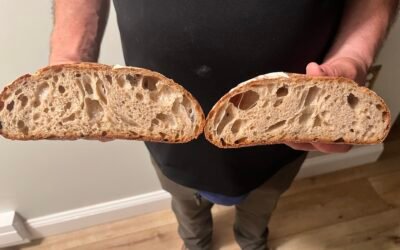
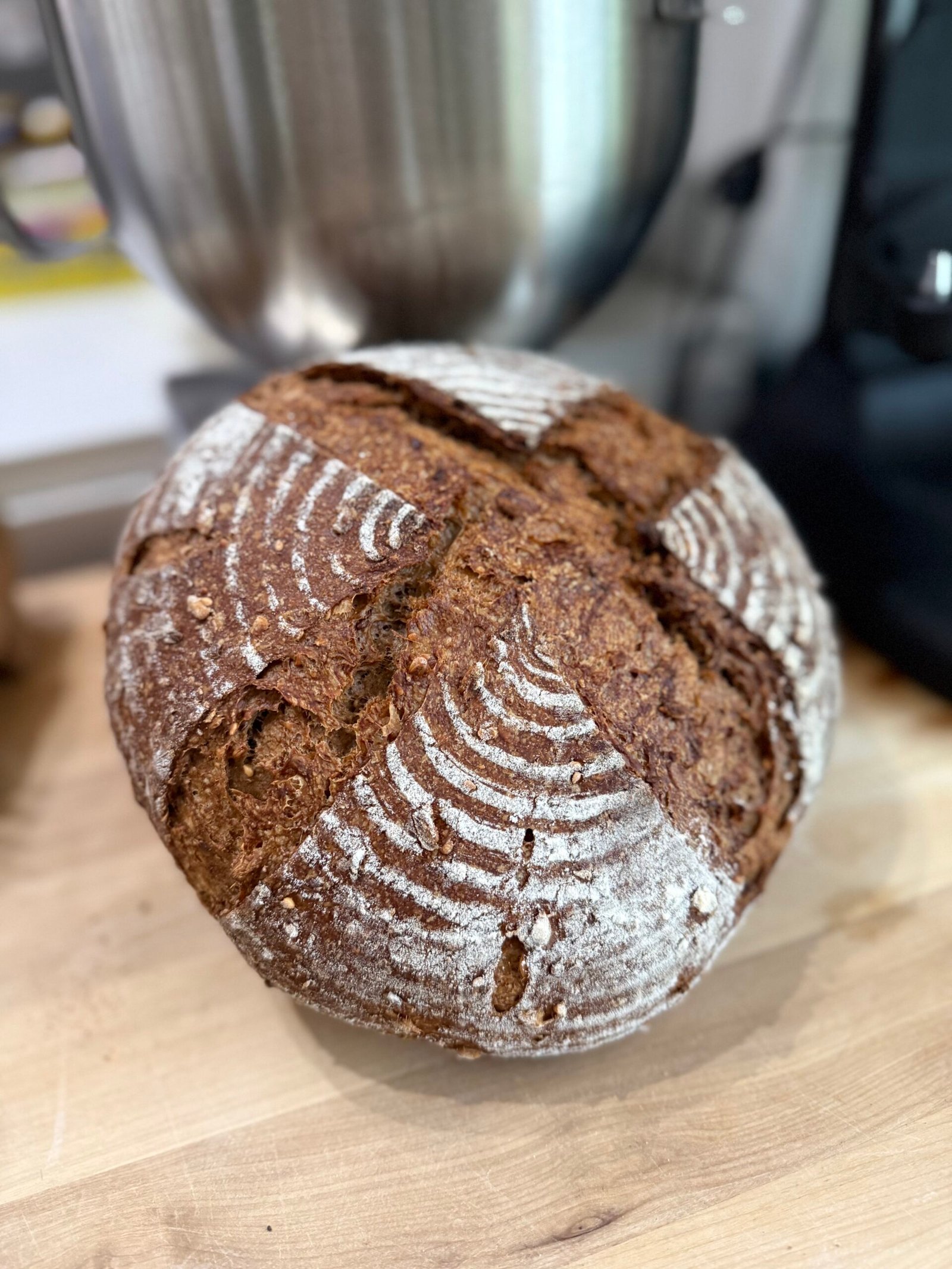
It started as a spreadsheet problem. I had a scaling calculator, a gift of rye berries from the wonderful Idaho-based regenerative family farmers Ancient Grains, and a 100% rye formula from Apiece. I also had a nagging question. Could I replicate a sourdough Austrian-style bread from SoHo bakery Rye by Martin Auer that sold for $60 a loaf? And was it worth the price?
After milling the rye berries in my own kitchen, I leavened the flour with my own starter. And then a larger question arose; why does a grain this good, this easy to grow, this central to a whole European baking tradition, barely register as an American crop at all? And how can a SoHo bakery be charging so much for a loaf of bread?
Run the real numbers — depending on whether you’re buying commodity or boutique rye, malted barley flour, a good finishing salt — and the flour, malt, and salt in a loaf this size costs somewhere between $3 and $11 to produce. That’s at most five to twenty percent of what Martin Auer charges.
The rest of that $60 goes to SoHo rent, a single-SKU show-bakery concept, an imported 57-year sourdough culture used as a brand story, and real, skilled, low-throughput labor. Once you price your own time honestly — say $25 an hour for the mixing, shaping, and (in my case) milling — a single hand-made loaf gets expensive fast, easily $45 to $58 all-in, even using rye that cost me nothing. Batch it up to four or eight loaves a session and the same loaf drops to $7–15.
| Batch size | Cost / loaf | vs. Martin Auer’s $60 |
| One loaf, solo session | $45–58 | 75–97% of the price |
| Batched, 4–8 loaves | $7–15 | 12–25% of the price |
The lesson that kept surfacing through every version of this spreadsheet: how much rye bread costs has almost nothing to do with rye, and almost everything to do with how many loaves you make at once. That SoHo bakery making batches is charging a hefty fee because they know that someone attempting this at home would be paying similar prices.
Why rye isn’t the American grain
Here’s the part that surprised me. I’d assumed rye was a German import, carried over by Pennsylvania Dutch settlers along with rye whiskey and dense, dark loaves. It isn’t. English colonists were already growing rye in Massachusetts by 1633 — decades before any significant German migration to Pennsylvania. Rye thrives in the kind of thin, acidic, unglamorous soil where wheat sulks, which made it a practical staple almost everywhere in the original colonies, “rye-and-Indian” bread (rye cut with cornmeal) included.
What actually killed rye’s status wasn’t taste or culture — it was the railroad. Once wheat grown on the praries of the Midwest could be shipped to every market in the country, there was no longer much reason to grow rye locally just because it tolerated your dirt. Beyond wheat offering better rise and softer crumb, it was prioritized because of its relatively lower price and gained convenience. In the process, rye was demoted to a specialty grain.
Rye’s second act was as a whiskey grain. In fact, rye whiskeys from Pennsylvania and Maryland were the dominant American labels sold well into the 1800s. Then they lost momentum when corn-based bourbon elbowed that market away too. Today only a small share of the roughly 2 million acres of rye planted in the U.S. is even harvested for grain; most of it goes in the ground as a winter cover crop and gets plowed under, never threshed at all. What’s left over for actual bread and whiskey flour is a genuinely small, specialty market — which is exactly why the family behind Ancient Grains are creating such value in growing and stone-milling organic rye in Idaho.
How Rye Fits Within the Larger Price of Grains
According to several AI search engines, the USDA’s current outlook has overall U.S. food prices rising around 3 percent in 2026. Bakery products run close to their normal 20-year average pace. They’re not the worst-hit category, but neither are they exempt from inflation.
Then there’s the Trump trade war with Canada. For most of 2025, Canadian agricultural trade stayed mostly insulated: roughly 90 to 95 percent of Canadian exports still moved into the U.S. duty-free under USMCA, even as Trump layered tariffs onto steel, aluminum, autos, and lumber. That insulation has since cracked.
After Trump placed 50 percent tariffs on roughly $20 billion of Canadian goods including dairy, alcohol, and cement. Canada answered dollar-for-dollar on September 8 with tariffs on nearly $28 billion of U.S. goods, targeting with real precision: cheese from Wisconsin, seafood from Maine, appliances from Kentucky — swing states, deliberately, with a midterm election in view. Canada’s own Industry Minister said as much out loud: “We are putting pressure clearly on different states and different people.”
Grain is now genuinely inside this fight, not outside it. The U.S. currently has a 25 percent tariff on Canadian wheat, barley, and oats — Cereals Canada, whose members ship most of their oats and a good share of their wheat south, put out a formal statement warning of “severe economic impact” on both sides of the border.
And that means grain that has to cross a border right now is sitting in a genuinely unsettled, tariff-exposed supply chain, while rye grown and milled on the same farm in Idaho never touches a customs form at all. Austrian rye flour shipped in for a SoHo bakery is an even sharper version of the same exposure. All to say that with Trump you get an exponential load of profiteers fighting to benefit from the hot house nature of his hermetically sealed kitchen.

0 Comments