
Cut, Paste, Bake: Learning Filove from a Baker Who Wouldn’t Give Me an Interview
The first time I asked Roberta Pezzella for an interview, she turned me down. As she put it, her English wasn’t good enough to do the conversation justice. I understood. I also didn’t let it go. I am still trying. Why?
Roberta Pezzella runs Pezz de Pane, a bakery in the Italian hill top town of Frosinone. As described by the Italian food site Agrodolce, it’s a “piccolo laboratorio 4.0” — a small, glass-walled, forward-looking bakery, open enough that you can watch the bread get made. It’s also one of the world’s innovations labs for baking bread.
Her bakery isn’t a nostalgic, flour-dusted throwback. It’s a working lab, built around refrigerated fermentation cells that let her control temperature precisely enough to walk in at 7am and still have loaves ready — a schedule most sourdough bakers would consider close to impossible.
That schedule is the tell for what actually changed in her baking. For years she worked with a firm starter she called “Thomas” — named, fittingly, for Thomas Piras, the maître and sommelier who co-founded Contraste in Milan. Then she went to San Francisco. Two weeks touring Tartine Bakery, Tartine Manufactory, and Josey rewired how she thought about bread entirely — not just the starter, but the whole rhythm of the work.
“IIl viaggio in America mi ha cambiato tutto,” she told Agrodolce: the trip changed everything, the vision, the calmer way of working, how she manages her starter, how she shapes the loaves. She retired Thomas and started building what she now calls, only half-jokingly, “San Francisco” — a liquid starter, a licoli, run the way Tartine runs theirs.
She hasn’t stopped traveling since. She went to Germany to study rye at Bäckerei Pfeifle. Australia. Copenhagen to where she repeatedly returns. Three registered trademarks came out of all this restlessness — Metodo Pezz, “Il Pane è una cosa seria”(Bread Is a Serious Thing), and Pezz de Pane itself — alongside seminars and consulting work of which she’s enormously protective. She’s on record turning away people looking for a quick education: “With a one-week consultation you get to nothing.”
Bread, to Roberta Pezzella isn’t a weekend hobby you can shortcut into. Franco Palermo — another baker she credits — put it to her more bluntly: bakery is sacrifice. From opening day until Easter, she told Agrodolce, she raised the shutters at five in the morning and got home at two the next morning. No Sundays. No Saturdays. “When others celebrate you work.”
Her whole product line is a kind of memorial to people she’s known. There’s Vito’s bread, durum wheat, for Vito Di Cecca. Franco’s bread — tipo 1, wholemeal, seeds — for Franco Palermo. And there’s Filove: stone-ground tipo 1 soft wheat, named for her friend Matteo Filone, a boxer. Ask her which one is her favorite and she says the question doesn’t make sense. They’re all her children.
No interview, however many requests, but something wonderful
While she never gave me an interview, Roberta gifted me a huge amount; screenshots, half-translated captions, a formulas copied and pasted one fragment at a time. Somewhere in the process of interacting with her, without ever sitting down for a proper Q&A, Roberta ended up teaching me more about Chad Robertson’s method than any interview probably would have. I’d been trying — and failing — to bake in the Tartine style for a while before that. She’s the one who finally made it click, mostly through sheer repetition and a baker’s patience for someone determined to understand.
The bread at the center of all this is called Filove.
The formula I pieced together
Roberta doesn’t publish recipes — she teaches them, in person, to people willing to put in real time. What I eventually assembled, in baker’s percentages relative to total flour weight, looks like this:
| Ingredient | Baker’s % | Weight |
|---|---|---|
| Farina tipo 1 | 70.00% | 198.1 g |
| Farina integrale (whole wheat) | 20.00% | 56.6 g |
| Farina tipo 2 | 10.00% | 28.3 g |
| Total flour | 100.00% | 283.0 g |
| Licoli (liquid starter) | 30.00% | 84.9 g |
| Sale (salt) | 2.00% | 5.7 g |
| Acqua (water) | 80.00% | 226.4 g |
| Total dough yield | 212.00% | 600.0 g |
The 80% figure is water measured against flour alone — it doesn’t count the water already sitting inside the licoli. Work that in (assuming a fairly standard 1:1 liquid starter) and the true hydration of the dough climbs closer to 82.6%. That’s a wet, loose dough, and it’s exactly what a tipo 1/tipo 2/whole-wheat blend at that ratio wants: enough structure from the blend to hold shape, enough water to open the crumb up.
The method, once I actually understood it
The piece I kept getting backwards, before Roberta straightened me out, was the order of operations. I’d been building the dough the way you’d handle a same-day loaf: mix, bulk ferment somewhere cold to buy time, then shape and proof warm. That’s backwards for Tartine-style bread, and it’s backwards for Filove.
The real sequence goes like this. Feed the licoli 8–12 hours ahead so it’s active and floats. Autolyse the flours with most of the water for half an hour to an hour. Mix in the licoli and salt. Then bulk ferment warm — room temperature, 3 to 4 hours, with folds through the first two — until the dough looks domed and alive but hasn’t doubled. Only then do you divide and shape it. The cold stage — the “celle frigorifere” that let Roberta open at 7am — comes after shaping, not before: the shaped loaf goes into a banneton and straight into the fridge for 8 to 16 hours. That cold spell isn’t a delay tactic. It’s the final proof. There’s no separate warm rise after it. The loaf comes out of the fridge cold, gets scored immediately, and goes straight into a hot oven — 250°C covered for 20 minutes, then uncovered around 230°C until the crust is properly dark.
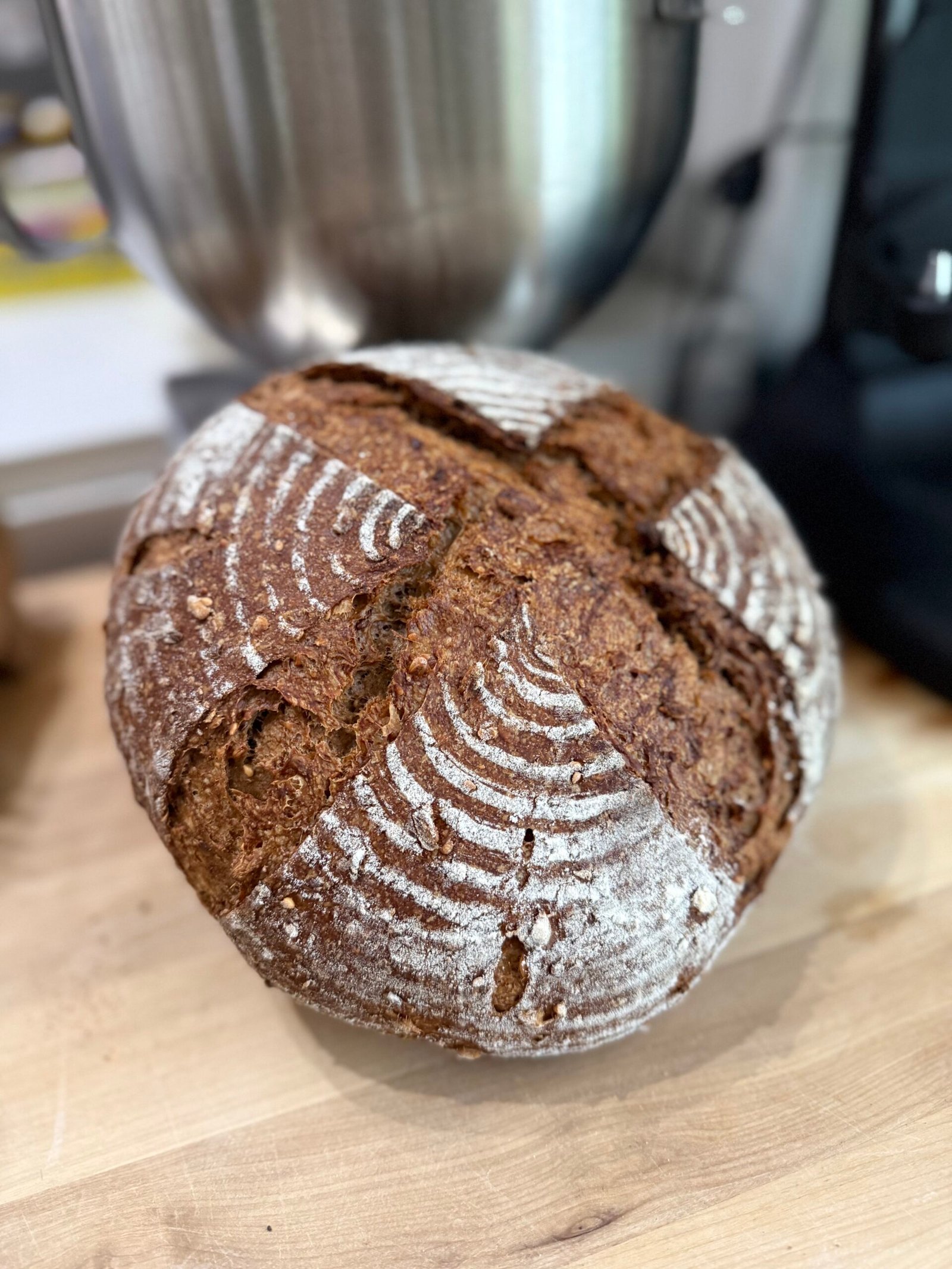
Baking a cold, fully-fermented loaf straight into that much heat is what produces the sudden, dramatic oven spring along the score — the “ear” that lifts cleanly instead of tearing. It’s also, not incidentally, what gives you that “moist, almost melting crumb” and “stratospheric crust” the Agrodolce piece described. I didn’t believe that description until I saw it happen on my own counter.
What came out of the oven
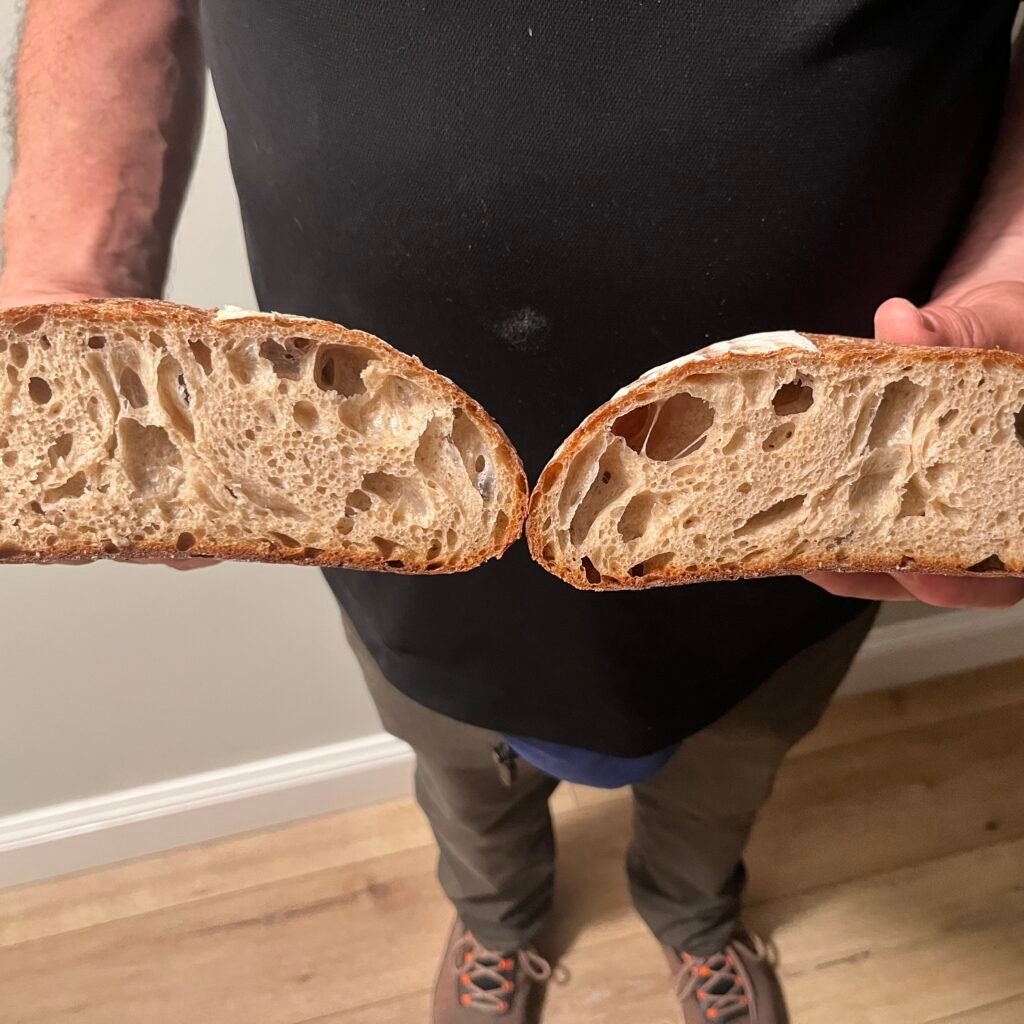
Open, glossy, irregular — exactly the crumb a properly cold-retarded, high-hydration dough is supposed to produce.
Deep, almost mahogany crust color from the long bake — this is the “stratospheric crust” the article promised.
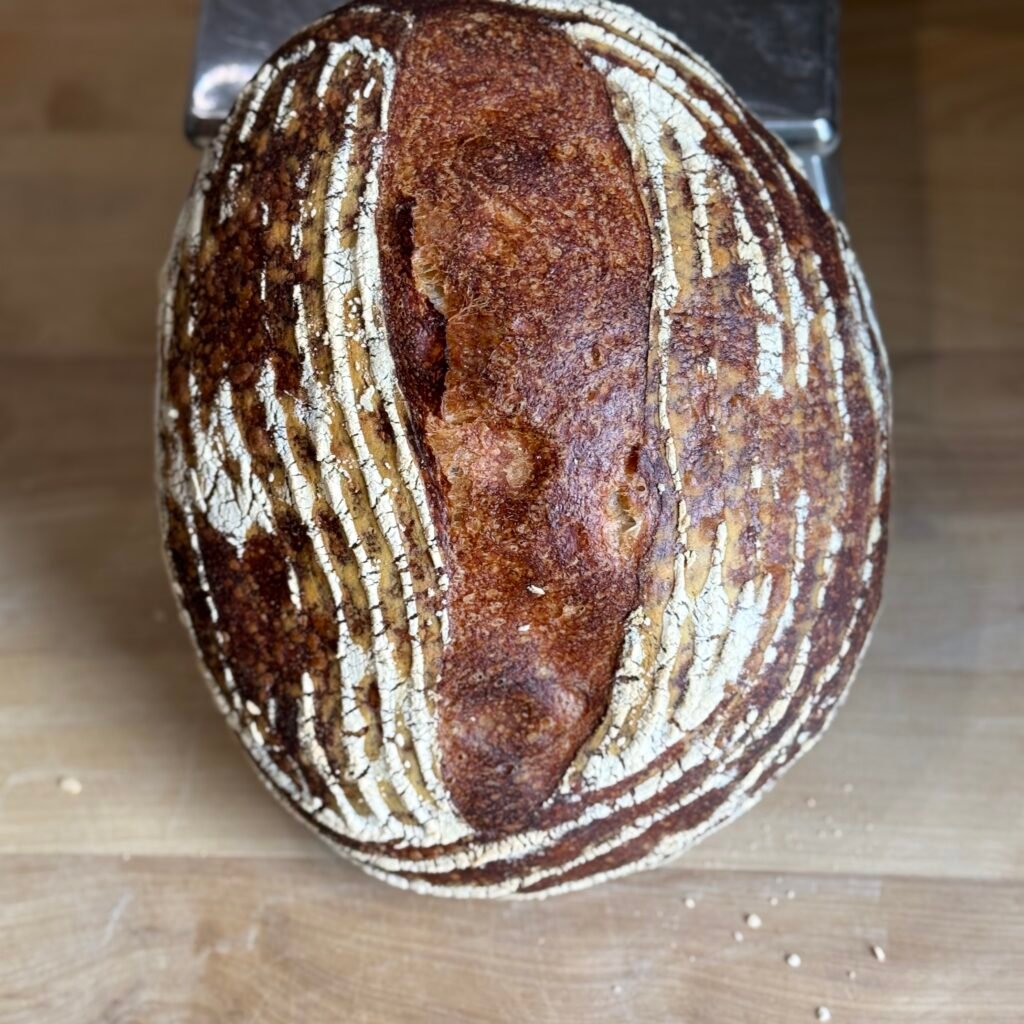
The ear tells the story: a clean split, a sudden lift, no tearing — the signature of dough that went into the oven cold and full of gas.
I still haven’t gotten that interview. I’m not sure I need it anymore. Somewhere between the screenshots, the half-translated captions, and finally getting the sequence of a Tartine-style bake right, Roberta taught me the thing an interview usually can’t: not what she thinks about bread, but how she actually makes it. Filove was the proof.
Source: Pezz de Pane di Roberta Pezzella a Frosinone — Agrodolce
0 Comments